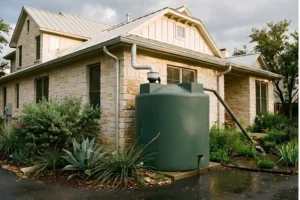
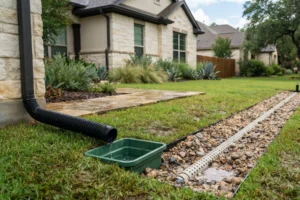
Central Texas weather loves to keep us guessing. One week the creek is dry, and the next week a storm dumps buckets on your roof. At Austex Sprinklers, we recently completed a rainwater harvesting installation for a family near Lake Travis, and the first big rain filled their collection tank in one afternoon.
The homeowner grinned like he had won a prize! Rainwater harvesting lets you collect that free water and save it for dry days when your lawn and plants need it most. Here are the methods that work best for Austin yards.
Why Does Rainwater Harvesting Make Sense in Austin?
Texas Water Is Not Unlimited
Drought is a regular visitor in Central Texas. When the lake gets low, water use rules get tight, and your lawn can suffer. Rainwater harvesting gives you your own water resource to use when the weather turns dry. It is a sustainable way to help your yard and your wallet.
Free Water Falls on Your Roof
A one-inch rain on a roof of 1,000 square feet can give you about 600 gallons of water. That is a lot of free water! Without a collection system, most of it runs down the driveway as runoff and heads to the storm drain.
What Are Rain Barrels and Do They Work?
The Simple Starting Point
A rain barrel is the easiest way to harvest rainwater. It sits under a downspout and catches water from the roof. Most barrels hold 50 to 80 gallons, and a hose attached near the bottom lets you water plants. We often tell new customers to start here, because barrels are cheap and quick to set up.
The Downside of Small Barrels
A barrel fills up fast. After one good storm, it is full, and the extra water spills out. If you want to run a sprinkler or water a large yard, one barrel will not be enough.
Which Larger Rainwater Harvesting Systems Work Best?
Above Ground Storage Tanks
Choosing the right rainwater storage tank depends on your available space, water needs, and budget. Here are the most common options we install around Austin:
Poly tanks are strong plastic tanks that hold 500 to 5,000 gallons, and they are a great pick for most homes.
Metal tanks look nice on a Hill Country property, and they last a long time when they are built well.
Slim line tanks fit along a wall or fence, so they work well on small lots.
Underground cisterns hide the water below the yard, which keeps it cool and saves space.
Match the Tank to Your Roof
The amount of water you can capture depends on your roof size and the rainfall. It’s also worth understanding the best time to install a rainwater harvesting system so your tank is ready before Austin’s next rainy season.
A bigger roof means more water to collect. We just did a job where the owner wanted a tiny tank for a huge roof. We talked him up to a bigger one, and now he never runs out in spring.
What Parts Does a Good Collection System Need?
Keeping the Water Clean
A good system has more than a tank. It needs gutters, a first flush diverter, and a screen. The first flush diverter lets the dirty first part of a rain runoff go, so leaves, dust, and bird surprises do not enter your tank. A screen keeps out bugs. Rainwater can pick up minerals or chemicals from the roof, so we always check the roof material first.
Getting the Water Where It Is Needed
A pump moves the stored water to a hose or irrigation line. Without a pump, you rely on gravity, and that can be slow.
A pump gives you steady pressure for your lawn and plants. At Austex Sprinklers, we can tie your tank into your sprinkler system, so the yard drinks rainwater on its own.
How Should You Use Your Collected Rainwater?
Best Outdoor Uses
Collected rainwater is great for outdoor jobs. Use it to water your lawn, flowers, trees, and vegetable beds. Plants love it because it has no added chemicals like some city water. Native plants such as cedar and many Texas favorites do very well with it.
What Not to Do
Do not drink it unless it has been treated and tested. Rainwater from a roof can carry germs, so keep it for yard use only. A good rule is to keep the lid tight, so mosquitoes stay away.
What Rules or Rebates Apply in Austin?
Check Local Policy
Texas supports rainwater harvesting, and the state even has a long history of helping people do it. Some cities and the local conservation district offer rebates or tax breaks for a system. Rules can change, so we suggest checking with your municipality before you buy a tank.
Frequently Asked Questions About Rainwater Harvesting
1. Is it legal to collect rainwater in Texas?
Yes, it is. Texas encourages rainwater harvesting, and you can collect rain from your own roof.
2. Can I drink collected rainwater?
No, not without treatment. Roof water can carry dirt and germs, so keep it for outdoor use unless a pro sets up a safe filter.
3. Can rainwater run my sprinkler system?
Yes, it can. With the right pump and filter, a tank can feed your irrigation lines.
Let’s Put Your Rain to Work
The best rainwater harvesting method depends on your roof, your yard, and your budget. Start small with a barrel, or go big with a tank and pump. Either way, you stop wasting free water.
At Austex Sprinklers, we just do this work for Austin neighbors, and we love hearing that the tank filled up after the first storm.
Call us today at (512) 721-8564, and we will help you plan a rainwater system that keeps your yard green, even when the sky turns dry.